Mine Island: How the Mechanics Work and Why They Are in Demand in India
Games with fast-paced rounds and the ability to stop the process yourself at a favourable moment have taken an important place in online casinos. Among them, Mine Island stands out – a project that combines the visual simplicity of arcade games with the monetary mechanics of gambling entertainment. In India, such formats have become widespread thanks to mobile access, local payment methods and a low entry threshold.
Mine Island Game Mechanics
Mine Island is based on a simple concept: a grid of cells, each of which hides either a multiplier or a trap. The player opens the cells one by one and can collect their current winnings at any time.
The gameplay consists of three steps:
- Selecting a bet before the round begins;
- Opening cells to increase the multiplier;
- Securing winnings before landing on a mine.
Each new cell opened increases the potential multiplier. If a trap is hit, the stake is lost entirely. This creates a direct correlation between how far you progress and the level of risk.
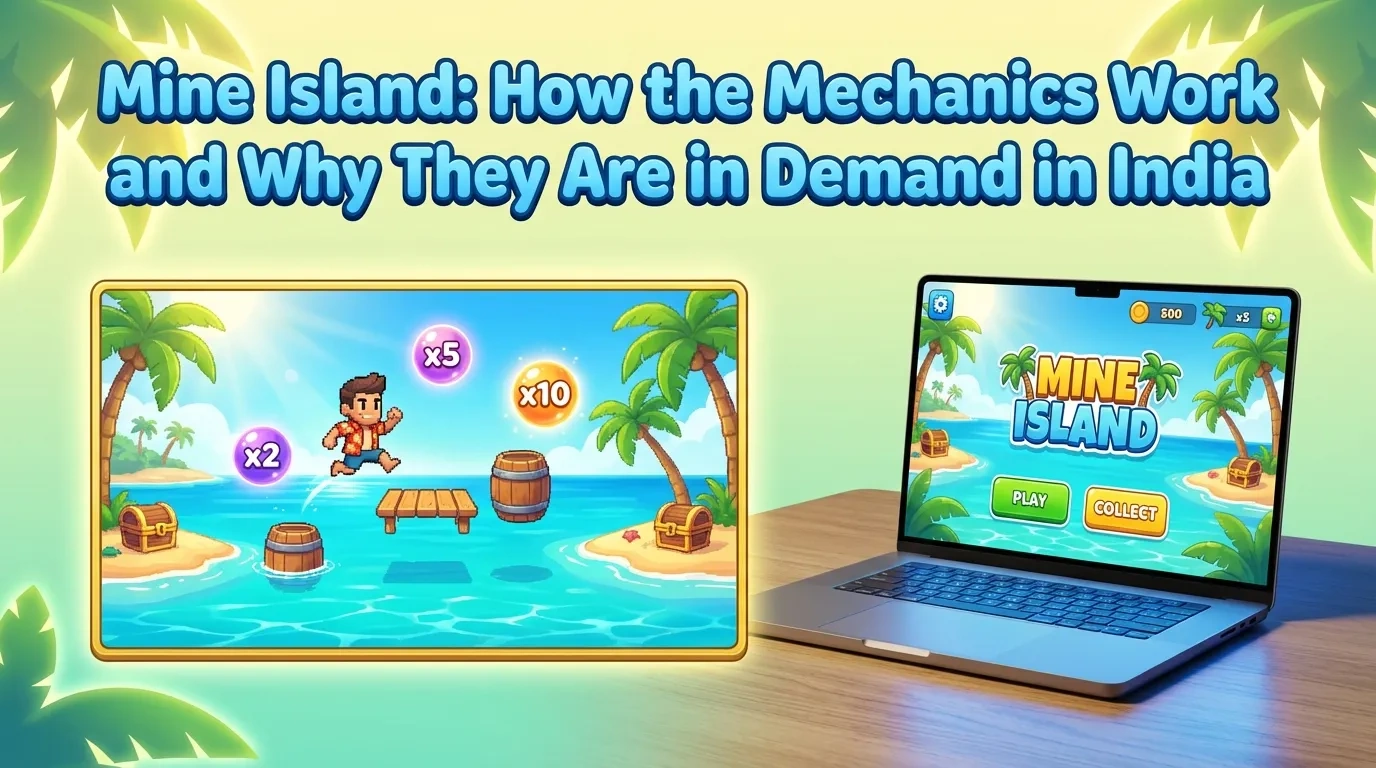
Visually, the game is designed as a character moving across an island. In some versions, a kangaroo is used, which ‘hops’ across the tiles. This does not affect the mathematical model, but adds dynamism and makes the process easier to follow.
The technical parameters indicate medium volatility and an RTP of up to 98%. This means a moderate frequency of wins with the possibility of obtaining a high multiplier. The demo mode serves a practical purpose: it allows you to understand the behaviour of the multipliers and the frequency of traps appearing without any financial risk.
Decision-Making and Player Behaviour
The main difference between the Mine Island online game and classic slots lies in the point of control. In slots, the result is fixed automatically after a spin. Here, the player themselves determines when to end the round.
The player assesses the current multiplier and the probability of continuing. A decision is made at every step. Even with randomly generated outcomes, there is a sense of control over the process. From a mathematical point of view, the result remains random. The distribution of traps is generated by an algorithm, often using a provably fair model.
Nevertheless, the behavioural model looks different:
- Players tend to notice small wins more often.
- Long winning streaks are perceived as a sign that the strategy is working.
- A run of bad luck prompts riskier decisions.
Within a single session, a shift in playing style can be observed: from cautious to aggressive. This is due to the short duration of each round — just a few seconds. Another factor is speed. In Mine Island, there are no pauses between stages. Once a round is over, the next one can begin immediately. This increases the number of bets per unit of time and affects the overall turnover.
Why Mine Island is Popular in India
The Indian online casino market is characterised by a high proportion of mobile users. Mine Island was originally designed to be played via a browser without the need for installation. There are several reasons for its growing popularity:
- The minimum stake is low, making the game accessible to a wide audience.
- Support for UPI, Paytm and bank transfers simplifies deposits and withdrawals.
- A single round takes just seconds. This suits mobile content consumption.
- The rules do not require players to study pay tables or complex combinations.
- Players are actively involved in the process rather than simply watching the outcome.
There is a growing interest among the Indian audience in games with instant results. This is linked to the habit of using mobile apps, where instant feedback is highly valued.
Mine Island grew out of existing concepts that have long been used in digital games. It is based on the familiar mechanics of ‘Minesweeper’, where the player reveals squares and tries to avoid hidden dangers, as well as elements of crash games featuring a rising multiplier and the need to cash out at the right moment. The combination of these two genres has created a distinct category that is currently developing rapidly.
One of the most common variations involves a grid with hidden mines. These games retain a grid of squares, and the player chooses which square to reveal. With each successful move, the multiplier increases, and the player can stop at any time. Developers often include the option to adjust the number of mines or the grid size. This affects the probability of winning and the rate at which the multiplier grows. Visually, such games are usually simpler, lacking characters and narrative elements, with the focus on pure gameplay mechanics.
Another notable segment is crash games. Here, there is no grid and no sequential opening of elements. The multiplier increases automatically over time, whilst the player observes the process and makes a decision once per round. If the player stops before the multiplier drops, the stake is multiplied by the current multiplier. If the moment is missed, the stake is lost. Despite differences in appearance, the logic of risk remains the same: an increase in the potential payout is linked to a rise in the probability of loss.
Hybrid solutions emerge at the intersection of these approaches. Mine Island game online is a prime example of this. The player interacts with elements on the board, as in mine-based games, whilst simultaneously controlling the timing of their exit, as in crash mechanics. Developers experiment with the details: adding extra levels, visual themes, and random events within a round. Yet the basic principle remains unchanged – the outcome is predetermined by an algorithm, whilst the player’s involvement lies in choosing the point at which to cash out their winnings.