Poker Straddles Across Mississippi and Button Variations
A poker straddle doubles the big blind, and the straddler acts last before the flop. Players add a third blind when using a straddle, which changes the preflop stakes and the order of action. With a live straddle, others must call a higher amount to stay in the hand. Some cash games allow straddles, but house rules determine which seats can post them.
Poker Straddle Basics
At many tables, players can place a poker straddle as a blind before cards are dealt. The straddle option follows the same rules in all cash game formats. Adding a straddle alters the structure of preflop action and increases the initial bet.
| Aspect | Description |
|---|---|
| Who can post | Player in permitted position |
| Chip posting moment | Prior to card distribution |
| Typical size | Twice the big blind |
| Relation to blinds | Creates third blind position |
| Preflop position change | Straddler acts last preflop |
| Whether cards seen first | Cards dealt only after posting |
| Impact on minimum call | Raises initial call amount |
| Impact on raises | Increases minimum raise size |
| How often allowed | Varies by house rules |
| Whether mandatory | Always voluntary, never required |
How The Optional Third Blind Works
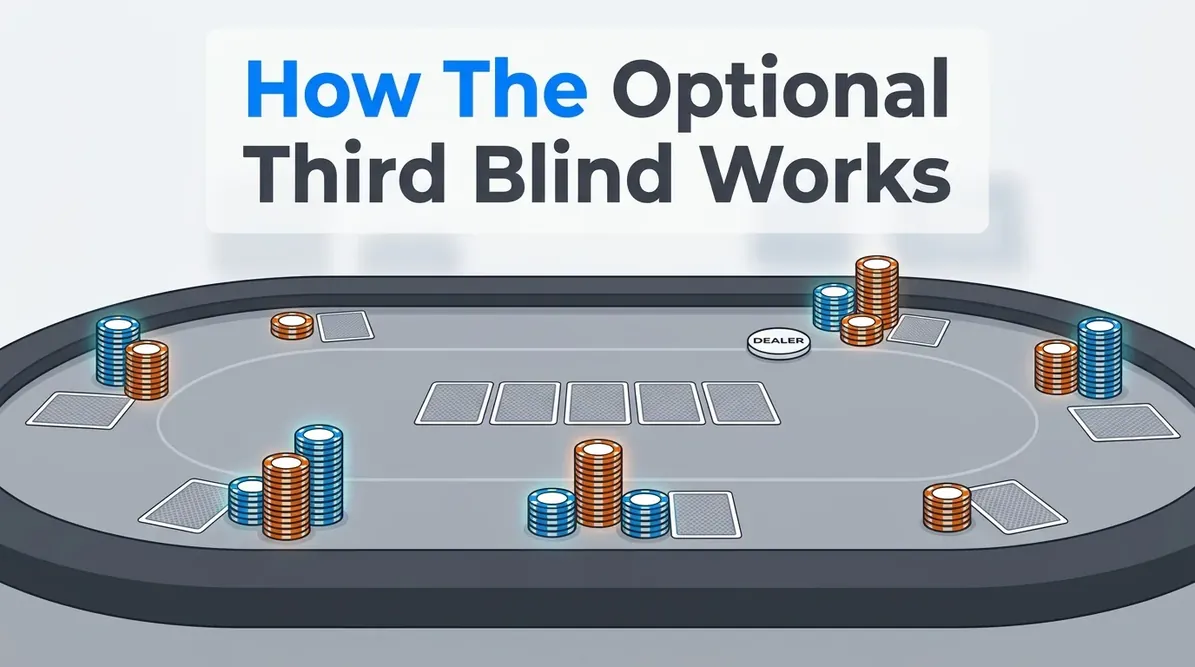
In most live cash games, players put in a third blind along with the small and big blinds. The table follows a set order to decide who places this blind.
- Posting standard blinds. The small blind and big blind post their required amounts;
- Declaring the optional blind. The straddler announces their intention to add the extra bet prior to card distribution;
- Placing chips. The straddler places chips equal to twice the big blind amount in front of their position;
- Dealing cards. The dealer distributes hole cards to all active participants;
- Starting action. The first player left of the straddler begins the betting round;
- Folding scenario. The optional blind returns to the straddler on a fold by all opponents;
- Uncalled chips. Uncalled amounts stay in the pot.
Pot Size Impact From Straddling
A straddle puts money in the pot by adding a third blind. This action raises the pot and the preflop stakes. Players then change their opening ranges and reconsider how much they want to commit.
- Bigger initial pot;
- Larger opening calls required;
- Wider isolation raises common;
- Earlier pot commitment occurs;
- Looser table play emerges;
- Increased variance per hand;
- Greater stack depth needed;
- Higher fold equity battles.
Usual UTG Straddle Position
The player seated to the left of the blind typically places the third blind. If a bet occurs, this position may have certain responsibilities.
- The seat sits immediately left of the big blind at the table position closest to mandatory bets;
- The player must post the straddle prior to card distribution;
- UTG no longer acts first preflop – the straddle creates a new opening bet;
- The straddler acts last preflop on raises or calls by other players;
- Opponents perceive the straddler’s table position differently – the voluntary bet alters action flow;
- The straddler receives final preflop decision rights instead of immediate action requirements.
Preflop Action Order With A Straddle
When an extra blind is posted, the standard preflop action sequence is changed. After the blind is posted, betting proceeds in clockwise order. This is different from the normal preflop action flow.
- Identifying starting position. Find the seat immediately left of the straddler to locate the first player;
- Beginning the sequence. The first player left of the straddler acts first and chooses to fold, call the straddle amount, or raise;
- Moving around the felt. Action continues to the next player in clockwise order;
- Reaching the blinds. Small blind and big blind face the same options to fold, call, or raise;
- Returning to the straddler. The straddler receives the final decision. All other players act first;
- Exercising straddle options. The straddler folds, calls any raise, or raises on the return of action;
- Closing the round. Betting ends after all active players match the highest bet.
Mississippi Straddle Mechanics
Some cash tables use the Mississippi straddle. This rule changes from the usual under-the-gun format. Players after the UTG spot can post the optional blind. This move changes who acts first in the betting sequence and affects how preflop betting flows.
| Feature | Standard Straddle | Mississippi Straddle |
|---|---|---|
| Who can post | UTG only | Button or other positions |
| Common positions | Left of big blind | Button or cutoff |
| Action starting point | Left of straddler | Left of straddler |
| Impact on blinds | Adds third blind | Adds third blind |
| Typical minimum size | Double big blind | Double big blind |
| Frequency in bigger games | Regular use | Very common use |
Button Straddle Structure
A button straddle creates distinct preflop conditions. It differs from traditional under-the-gun formats and changes how betting unfolds prior to the flop. The button straddle modifies who acts last before the flop, alters standard positional incentives that favor late position play, and shifts preflop advantages.
- Button posts the straddle bet;
- Amount equals twice big blind;
- Small blind opens preflop action;
- Button receives final preflop decision;
- Operates alongside existing blind structure;
- House rules determine button straddle availability;
- Interacts with established room policies;
- Postflop action follows standard order.
House Rules Controlling Straddles
Each live poker venue sets local policies that specify when and how players may use a straddle, with house rules determining whether posting bets is allowed and defining straddling procedures at each table.
| Policy Category | Typical Restriction | Alternative Option |
|---|---|---|
| Eligibility by seat | UTG only | Button or cutoff allowed |
| Minimum size | Twice big blind | No lower limit |
| Maximum size | Four times big blind | Unlimited cap permitted |
| Re-straddles allowed | No re-straddle | One additional re-straddle |
| Frequency limit | Every hand permitted | Once per orbit maximum |
| Declaration timing | No cards dealt yet | Verbal announcement required |
| Button option | Not permitted | Button straddle allowed |
| Cutoff option | Not available | Cutoff straddle permitted |
Raise Sizing With A Live Straddle
A live straddle serves as the initial bet. In no-limit games, players must raise by at least double the straddle amount. In pot limit games, players base their calculations on the current size of the pot. Action proceeds around the table, and all players follow these updated rules.
- Call equals straddle amount;
- Minimum raise doubles the straddle;
- No-limit raises can exceed minimums;
- Pot limit builds from current total;
- Straddler receives final preflop decision;
- Unopened action allows straddler check;
- Reraises follow established minimum raise rules;
- Returns to straddler reset options.
Standard Blind Action Without A Straddle
Preflop action relies on the blind system. Players contribute required amounts. Betting order depends on player positions. Costs and order remain unchanged due to no additional blind.
- Small blind posts the smaller forced bet to the dealer’s left;
- Big blind posts the larger forced bet one seat left of the small blind position;
- Action starts with the player seated immediately left of the big blind;
- Each player can fold, call the current bet amount, or raise the stakes;
- Big blind can check with no raise on the return of action to them;
- A raise reopens betting and allows all remaining players to respond;
- The hand advances to postflop streets on completion of all preflop action.
Postflop Action After A Preflop Straddle
The preflop straddle alters how the betting round unfolds. This round concludes when the dealer reveals the community cards. Once the flop appears, the straddle no longer influences the action. From that point, postflop betting proceeds in positional order, without regard to any earlier extra blind.
- First seat acts after button;
- Small blind acts first usually;
- Big blind follows small blind;
- Button retains final postflop position;
- Postflop order remains unchanged typically;
- Button straddle can shift blind duties;
- Later streets follow the same postflop order.
Games And Stakes That Commonly Allow Straddles
In cash games, players use straddles to create more action, but the options and rules for straddle placement depend on the game format and stakes, with each format setting its own guidelines.
| Format | Allowed Positions | Mississippi Frequency |
|---|---|---|
| No limit hold’em low stakes | UTG only | Rare |
| No limit hold’em mid stakes | UTG plus button | Occasional |
| High-stakes cash tables | Any position | Common |
| Pot limit Omaha | UTG or button | Occasional |
| Mixed dealer’s choice | Varies by round | Rare |
| Private home games | All seats permitted | Very common |
| Tournament formats | Usually prohibited | None |
Strategic Reasons To Post A Straddle
Posting a straddle may seem illogical since it raises the pot and limits positional advantage, yet players still choose to straddle for various reasons, many of which are not strictly mathematical.
- Accelerate overall hand pace;
- Exploit deep stack advantages effectively;
- Create chaotic table image rapidly;
- Assume the action player role;
- Pressure tight opponents aggressively;
- Generate larger pots proactively;
- Disguise premium hand strength;
- Test opponent adjustment speed.
Adjusting To Opponents Who Straddle
When opponents post straddles, players must adjust their strategy. The straddler’s decisions, both before and after posting, influence how others respond. Different types of players use straddles for their own reasons and prefer certain hand ranges. The way the straddler plays can suggest which actions may be effective.
| Opponent Type | Common Straddle Tendency | Recommended Adjustment |
|---|---|---|
| Tight players | Straddle infrequently | Widen value range |
| Loose players | Straddle often recklessly | Tighten premium hands |
| Aggressive regulars | Straddle for position control | Exploit position advantages |
| Recreational gamblers | Straddle without strategy | Raise wider profitably |
| Tight-aggressive opponents | Straddle selectively | Respect their holdings |
| Passive callers | Straddle chasing action | Build larger pots |
Stack Depth And Straddle Decisions
Stack size affects how players handle straddles. The number of chips in play determines the reasonableness of posting or calling a straddle and influences the profitability of straddles. Shallow stacks increase the risk involved.
Strategic considerations are influenced by stack depth.
- Short effective stack reduces maneuverability;
- Shallow depths favor folding more;
- Deep effective stack increases options;
- Large reserves improve implied odds;
- Medium depths require careful evaluation;
- Position becomes more valuable deep;
- All-in risk rises at shallow depths;
- Reraise options expand with depth.
Multiway Pots And Straddled Hands
Straddles increase the size of preflop pots. When a straddle is in play, more players tend to call, which alters how players’ ranges interact. The amount of dead money rises, and multiway situations become more frequent as a result. Players notice these changes and adjust their strategies accordingly.
| Scenario | Action Pattern | Strategic Impact |
|---|---|---|
| Limpers call straddle | Multiple callers enter | Creates multiway pot frequently |
| Raiser attempts isolation raise | Raise to three-bet size | Isolation raise reduces field |
| Equities run closer | Hands converge in value | Favorites lose edge multiway |
| Premium pairs hold | Strong overpairs maintain strength | Retain value against draws |
| Speculative hands gain | Suited connectors improve odds | Implied odds increase sharply |
| Drawing hands profit | Flush and straight draws | Better pot odds justify calls |
| Bluffs become costly | Fold equity drops sharply | Multiple opponents resist pressure |
Summary Of Key Straddle Concepts
Straddles are an optional rule that alters preflop action and affects pot size. When deciding on straddles, players consider mechanics, order, flexibility, and stakes. These elements outline how straddles function.
- Optional third blind bet;
- Straddler gains last preflop action;
- Action starts left of straddler;
- House rules determine straddle eligibility;
- UTG and button variations exist;
- Larger initial pot and commitment;
- Strategic tradeoffs balance aggression and risk.
FAQ
What Is The Main Point Of A Poker Straddle?
A poker straddle occurs when a player places extra chips before cards are dealt, adding action, raising the stakes, increasing the pot size, and shifting the initial bet to the straddling player.
How Does A Button Straddle Affect Position?
A button straddle changes the usual preflop order, making the small blind act first and giving the button the last action before the flop.
Do Tournaments Ever Allow Straddles?
Straddles are typically found in cash games. In tournaments, voluntary blind increases are rarely permitted. Standard blind schedules govern action and competitive balance in tournaments, and optional additional bets are prohibited in tournament play.
Should New Players Use Straddles?
Most new players should avoid straddles, as raising the opening bet increases bankroll risk and usually outweighs any positional advantage. Standard blinds already provide enough opportunities to learn basic strategy and hand evaluation.