How to Read Poker Starting-Hand Charts and Interpret Range Grids
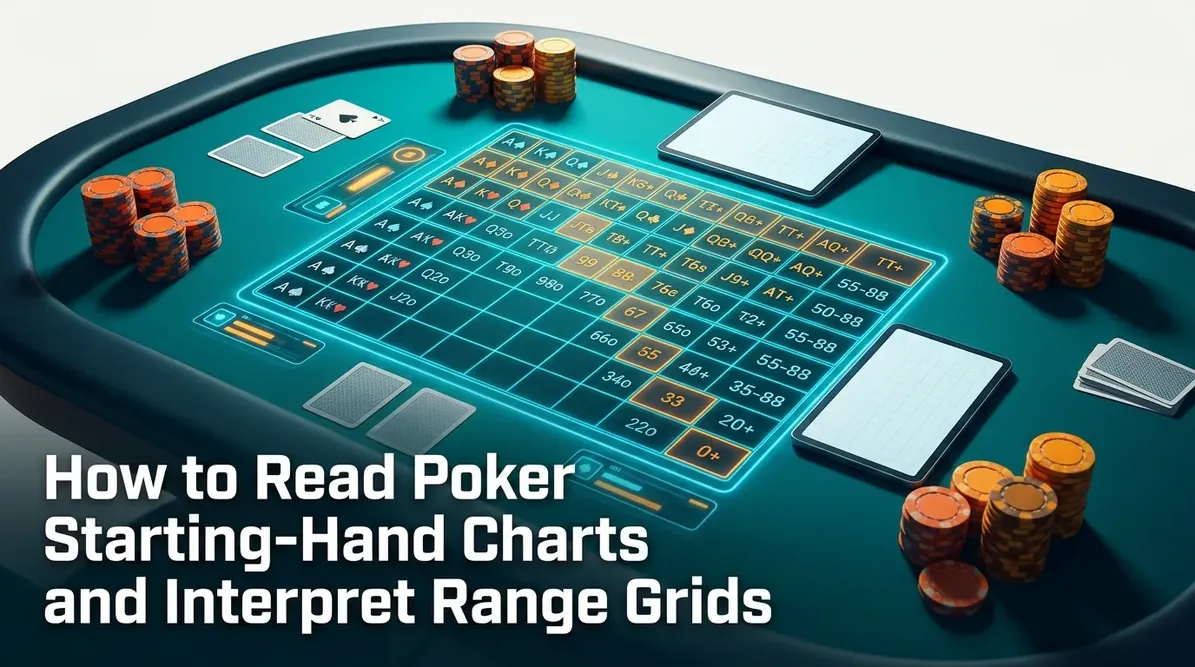
Poker starting-hand charts guide Texas Hold’em players in choosing whether to raise, call, or fold. Each chart displays all possible two-card combinations dealt before the flop. The article presents the 13-by-13 hand matrix and clarifies the symbols used for suited and offsuit hands. It defines the meanings of plus signs and dash-range notation. The writer lists opening ranges for every table position and explains how range percentages are calculated. The text also identifies common mistakes players make.
Starting Hand Chart Basics
Players use charts to make their preflop decisions. During a session, they check these charts on a screen or on paper. This method helps them find information quickly.
| Chart component | Concrete description |
|---|---|
| Hand class count | 169 distinct two-card combinations |
| Pocket pair label | Two identical ranks without suffix |
| Suited indicator s | Both cards share one suit |
| Offsuit indicator o | Cards have different suits |
| Plus sign usage | Includes listed hand upward only |
| Dash range meaning | Continuous interval between two endpoints |
| Position assumption | Location relative to button defines range |
| Stack size assumption | Depth stated in big blinds |
| Color legend role | Defines raise, call, fold actions |
| Percentage label meaning | Counts combinations, not grid squares |
| Opening action label | Applies with no prior pot entry |
| Defending action label | Response to opponent raise or bet |
Reader Profile And Chart Usage
Some poker players rely on preflop charts. These charts offer guidance that takes into account stack size, seat position, and previous actions. Players review these factors before making a decision.
- New cash player;
- Multi-table tournament regular;
- Online six-max grinder;
- Live full-ring player;
- Study-time solver user;
- In-game quick reference;
- Equity calculator user;
- Training-course student.
What Starting Hand Charts Show
No single chart applies to all situations. Each starting-hand chart offers advice for a specific preflop choice. Some charts indicate when to raise from the button, while others guide decisions about defending against a cutoff raise or calling from the small blind.
- Action type shown: raise, call, fold, or mixed frequency;
- Stack depth assumption: commonly 100 big blinds;
- Blinds and antes: tournament antes widen ranges;
- Table size assumption: six-handed versus nine-handed;
- Open-raise hands: first entry into the pot;
- Call or defend hands: responding to opponent aggression;
- Fold hands omitted: left blank or unmarked;
- Mixed-frequency actions: split between multiple actions;
- Raise sizing baseline: typically 2.5× or 3× the big blind.
How The 13 By 13 Matrix Works
The matrix displays a 13-by-13 grid showing all possible starting hands, with hand classes arranged by rank from aces at the top to deuces at the bottom.
- Rows display the first card rank in each hand class;
- Columns display the second card rank in each hand class;
- Diagonal cells contain all 13 pocket pairs from AA to 22;
- The upper-right region holds suited hand classes marked with “s”;
- The lower-left region holds offsuit hand classes marked with “o”;
- The matrix contains 169 total hand classes that cover every strategic possibility;
- Notation remains independent of recommended action or position;
- Players read hands by matching rank labels across rows and columns;
- The grid provides notation structure, not universal strategy advice.
Pocket Pairs On The Diagonal
Pocket pairs consist of two cards with identical rank. In the 13-by-13 matrix, these hands appear along the diagonal. Players use specific notation to refer to pocket pairs, which hold strategic significance.
- AA, KK, and QQ represent the top three pair classes;
- No s or o suffix attaches to pair notation;
- Six exact combinations exist per pair class;
- Thirteen distinct pair classes span the diagonal;
- 22+ notation covers all thirteen pair classes;
- TT+ identifies high and premium pair classes;
- Small, medium, and big categories each cover a distinct rank segment;
- Diagonal cells hold all pair classes from AA to 22.
Suited Hand Notation Explained
Writers use hand notation to indicate when both hole cards share the same suit. They add the letter “s” to mark this, which helps distinguish these combinations from other hands.
- The letter “s” denotes two cards of identical suit;
- AKs means ace-king suited, both cards share hearts, diamonds, clubs, or spades;
- A5s means ace-five suited, which represents four specific combinations;
- Four suited combinations exist for each unpaired suited class;
- Flush potential exists only with both hole cards sharing one suit;
- Suited designation does not guarantee strong preflop value;
- K2s contains gaps between ranks despite suited status;
- Suited broadway hands form a separate strength category;
- Suited aces create a distinct hand family on charts.
Offsuit Hand Notation Explained
Offsuit hands consist of cards from different suits. The letter “o” identifies an offsuit hand. On the hand grid, the offsuit section appears in the lower-left corner.
- Letter “o” definition: The symbol indicates two cards of different suits;
- AKo example: Ace-king offsuit contains one ace and one king of different suits;
- JTo example: Jack-ten offsuit contains one jack and one ten of different suits;
- Twelve combinations: Each offsuit unpaired class contains twelve exact combinations;
- Three times more frequent: Offsuit combinations occur three times more often than suited ones;
- Limited flush potential: Offsuit hands cannot make flushes that use both hole cards;
- Offsuit not always weak: High-card strength remains valuable regardless of suit status;
- Broadway category: Offsuit broadway hands like AQo and KQo maintain strategic value.
Plus Sign Range Notation
The plus sign appears frequently in poker charts and training materials. It expands a listed hand upward in rank within the same category, following strict rules based on hand category and rank hierarchy. The plus sign does not extend downward. This notation simplifies range descriptions.
Range expansion follows recognizable patterns. Each stage mirrors the previous one. In every case, the sequence remains unchanged.
- 22+ means all pairs: The notation includes every pocket pair from deuces through aces;
- QQ+ identifies high pairs: The range contains queens, kings, and aces;
- ATs+ covers suited aces: The notation expands to ATs, AJs, AQs, and AKs;
- A2s+ means all suited aces: Every suited ace-x combination enters the range;
- KJo+ includes KQo: The offsuit king range expands only to KQo;
- Understanding upper boundary: The listed hand establishes the lower limit;
- Plus sign for charts: This symbol saves space and clarifies hand groups;
- Avoid misreading downward: The notation never includes weaker hands than specified.
Dash Range Expressions
A dash between hands indicates a block that covers both endpoints and all classes within that range. Hands outside the interval are not included by the dash.
- 55-88 covers four consecutive pair classes: 55, 66, 77, and 88;
- A5s-A2s moves downward through suited aces: A5s, A4s, A3s, and A2s;
- 76s-54s spans three connector classes: 76s, 65s, and 54s;
- Endpoints stay included on both sides of the interval;
- Outside hands remain excluded from the defined range;
- Endpoint order indicates the direction of the range expansion;
- Pocket-pair ranges frequently use dash expressions;
- Suited-connector ranges commonly appear with dash notation;
- Interval boundaries determine which classes belong inside the range.
Hand Combinations And Percentages
In Texas Hold’em, each player receives two cards. There are 1,326 possible unique combinations of two cards, which fall into 169 distinct hand classes. Most training software and solver outputs display equity percentages based on these combination totals.
- 1,326 total combinations exist;
- 169 hand classes organize those combinations;
- 13 pocket-pair classes appear on the diagonal;
- 78 suited classes occupy the upper-right triangle;
- 78 offsuit classes occupy the lower-left triangle;
- Six combos per pair contribute to pocket-pair frequency;
- Four per suited class create suited-hand totals;
- Twelve per offsuit class create offsuit-hand totals;
- Percentages count combinations accurately;
- Colored cells mislead with differing combination counts.
Position Based Opening Ranges
Seat position influences how players select their opening hands. Players in earlier seats face more opponents and therefore choose hands from tighter ranges. Each seat requires players to adjust their assumptions about hand strength. Those in later seats can select from a wider range of hands. The button allows for the widest range of choices.
| Position | Example Open Percentage | Description |
|---|---|---|
| UTG | 14,3% | Tightest opening range overall |
| Hijack | 18,9% | Moderate selection expansion |
| Cutoff | 25,5% | Wider profitable hand selection |
| Button | 43,3% | Widest opening frequency observed |
| Small Blind | 33,0% | Position offset by blind |
| Big Blind vs Button | 52,3% | Defense higher than opening |
Opening Ranges Versus Defending Ranges
Opening ranges are the hands chosen when no player has entered the pot, while defending ranges apply from the blinds after a raise. This distinction determines which preflop chart should be used.
- Open-raise definition: A raise-first-in action occurs after all players prior to the raiser folded;
- Defending call or three-bet: Defense involves calling or reraising after an opponent opens;
- Big blind defending example: A player in the big blind defends against a button open-raise;
- Tighter versus early raises: Defending against under-the-gun opens requires stricter hand selection;
- Wider versus late raises: Button and cutoff raises allow broader defending frequencies;
- Chart labels for RFI: Raise-first-in charts indicate opening situations;
- Chart labels for defend: Defense charts specify the original raiser’s position;
- Importance of raise size: Different raise amounts alter optimal defending frequencies;
- Positional contrast: Opening from the button differs completely from defending the small blind.
Chart Colors And Range Percentages
Most starting-hand charts use colors, legends, and percentage labels to show which actions to take with each hand; understanding how colors match combination-weighted percentages helps players minimize errors.
- Raise cells: Red, green, or other bright shades typically mark hands for raising;
- Call cells: Yellow, orange, or muted tones often represent calling ranges;
- Fold cells: Blank or white squares indicate fold decisions;
- Mixed-frequency cells: Some charts use gradients or patterns to show hands played at varying frequencies;
- Empty squares default to folding – check the legend for any override;
- Half grid not fifty: A half-filled matrix does not automatically represent 50% of combinations;
- Combination-weighted percentages: Offsuit hands contribute more combinations than suited hands, which shifts true percentages;
- Legend always required: Every chart must include a legend that defines each color and action;
- Percentage printed below: Accurate range percentages appear beneath or beside the grid.
Blockers And Card Removal
Each round, hole cards and community cards remove combinations from the deck, reshaping opponent range possibilities. As these known cards appear, exact hand frequencies change throughout the round. The removal effect alters range weights and influences strategic decisions.
- Preflop AA contains six combinations with no cards on the board;
- One ace on the board reduces AA to three combinations;
- Holding one ace in your hand reduces opponent AA to one combo;
- Holding the ace of spades removes all spade-suited combinations containing that card;
- Bluff combination counts drop with potential bluffing hands in your holding;
- Value combination counts drop with value-bet cards in your holding;
- Card removal effects compound with multiple known cards sharing ranks or suits.
How Ranges Change After Actions
A range represents a set of possible hands with assigned weights. Bets, calls, and checks shift the weights of the range but do not prove exact cards. Each opponent action provides new information about hand distribution.
After each action, players refine their ideas about their opponent’s hand. This refinement involves running through several steps.
- Adjust range composition immediately after an open-raise narrows the initial 100% range;
- Tighten the estimated distribution after observing a large three-bet from an opponent;
- Keep strong value hands inside the updated range after an opponent checks on a draw-heavy board;
- Include balanced bluffing hands within the betting range on river streets;
- Remove impossible combinations after board cards appear and eliminate matching pocket pairs;
- Factor observed player tendencies from previous hands into current range construction;
- Recalculate combination counts after each new action modifies the weighted distribution.
Stack Depth And Game Type
Chart creators design charts for specific stack sizes and table types. A range that works with 100 big blinds may not be effective for shorter or deeper stacks.
- Stack size heavily determines preflop strategy and chart selection;
- A 100-big-blind baseline represents the standard depth for most published ranges;
- Deeper stacks allow slightly tighter opening ranges and more postflop maneuvering;
- Shallow stacks require more frequent all-in decisions and broader ranges;
- Push-fold charts become relevant around fifteen big blinds or fewer;
- Antes widen opening ranges by adding dead money to every pot;
- Cash games typically feature deeper stacks than tournament situations;
- Tournaments feature changing stack sizes throughout different blind levels;
- Table size shifts position definitions and alters opening frequencies.
Common Chart-Reading Errors
Players sometimes miss details or overlook assumptions, which can lead to mistakes during play. To avoid errors related to position, stack depth, or previous actions, each person should read every chart label twice before using a range.
- Treating the matrix like a universal tool – a raise-first-in chart does not fit defense decisions;
- Reading suited cells backward – suited hands appear above the diagonal, not below;
- Confusing AKs with all AK – AK notation includes both suited and offsuit combinations;
- Misusing ATs plus direction – ATs+ expands upward through AJs, AQs, and AKs;
- Adding suffixes to pocket pairs – 22s or AAo notation does not exist;
- Counting squares instead of combinations – offsuit cells contain twelve combinations, suited cells four;
- Mixing suited with connected – K2s shares suit but no connector relationship;
- Using open charts after raise – opening ranges do not apply after opponents act;
- Ignoring stack assumptions – 100 big-blind charts do not fit 15 big-blind stacks;
- Misusing blind defense ranges – big-blind defense does not apply to cutoff situations.
Conclusion On Reading Charts
Players must learn the matrix layout. They should identify suited and offsuit suffixes and use the plus sign to expand a range. Counting combinations is essential. Mastering chart notation, position labels, and assumptions allows players to translate shorthand into specific hand selections and frequencies. Through this process, grids become tools for learning. The charts serve as reference sources rather than simple symbols.
- Learn the 13-by-13 matrix layout and recognize which quadrant holds suited combinations;
- Read the “s” and “o” suffixes to distinguish four-combination suited classes from twelve-combination offsuit classes;
- Understand plus-sign notation expands upward and dash notation defines continuous intervals;
- Think in exact combinations rather than colored squares to calculate accurate range percentages;
- Adjust opening ranges for position and recognize that button frequencies differ from under-the-gun frequencies;
- Consider stack depth and table format assumptions prior to applying any published chart;
- Avoid common mistakes such as confusing suited notation with connected hands or applying opening charts after opponents raise.
FAQ
How Do Poker Charts Work?
Poker charts match every possible two-card hand with a suggested preflop move. These charts consider table position, stack sizes, and table dynamics. Players check these charts before community cards are dealt.
Which Hands Should I Open?
Opening hand advice varies by position, stack depth, and chart assumptions. Under-the-gun opens about 14% of hands, while the button opens approximately 43% of hands. The difference in opening percentages illustrates the impact of position on range size and hand selection.
What Does 22 Plus Mean?
The notation 22+ refers to all pocket pairs, starting with twos and ending with aces. In Hold’em, a player can be dealt thirteen distinct pocket pair types. Together, these pairs account for seventy-eight possible combinations.