Poker Outs and the Rule of 2 and 4 Decoded
Poker outs are unseen cards that can improve a player’s hand. Players count outs to estimate their winning chances, but they must distinguish between clean and dirty outs to avoid overestimating their hand strength. After the flop, there are 47 unknown cards, which becomes 46 after the turn. The Rule of 2 and 4 helps calculate drawing odds: with one card left, players multiply their outs by two, and from the flop to the river, they multiply by four. Identifying clean outs allows players to compare their equity to pot odds for informed betting decisions.
Core Concepts Of Poker Outs
To figure out poker outs, consider the cards left in the deck, the cards on the board, and the hands your opponents may have. The next sections explain each part.
| Aspect | Detail |
|---|---|
| Deck Size | 52 cards total available |
| Definition Of Out | Card that improves current hand |
| Improving Versus Winning | Improvement does not guarantee victory |
| Community Cards Shown | Flop reveals three board cards |
| Hand Changes By Street | Each street reduces unseen cards |
| Clean Outs Idea | Cards that complete strongest hand |
| Dirty Outs Idea | Cards that improve but lose |
| Shared Outs | Multiple draws use same card |
| Blocked Cards | Opponent holdings reduce available cards |
| Board Texture | Paired boards weaken straight draws |
| Opponent Range | Holdings determine poker outs value |
| Recalculation Need | Update counts after each street |
Counting Outs Step By Step
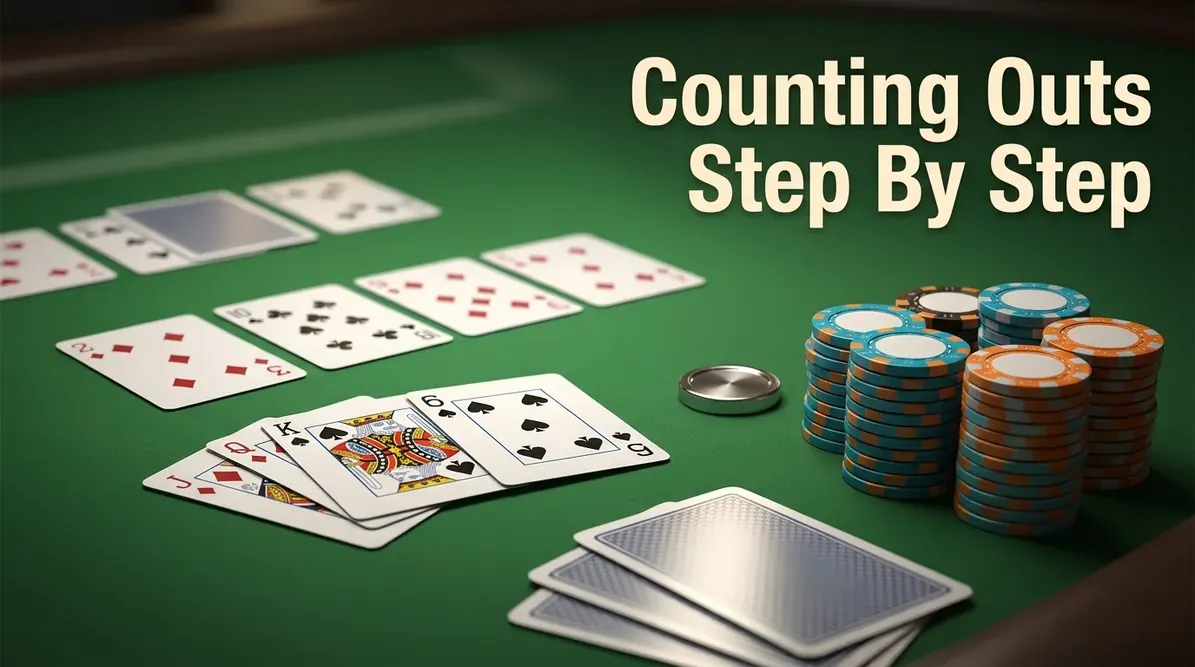
Accurate count outs require a structured approach. This eliminates common errors and ensures reliable draw calculations.
- Identify the target hand that will win the pot;
- Count all remaining ranks or suits that complete this hand;
- Subtract cards visible on the board from the count;
- Deduct cards visible in your hand from the count;
- Remove duplicate cards counted in multiple draw categories;
- Adjust for stronger hands opponents hold in their range;
- Recalculate poker outs after each new community card appears;
- Verify that each out produces the intended winning combination.
Unseen Cards After The Flop
The table shows how many cards players have not seen at each stage of the hand. When the dealer turns over a community card, the set of possible cards becomes smaller. Players need to adjust their odds as each new card appears.
| Street | Cards Known | Unseen Cards | Use In Odds |
|---|---|---|---|
| Preflop | 2 hole cards | 50 remain | Preflop equity math |
| After Flop | 5 total | 47 remain | Use for turn math |
| After Turn | 6 total | 46 remain | Use for river math |
| Multiway Flop | 5 plus blockers | Fewer than 47 | Adjust blocker count |
Turn Card Draw Probabilities
Single card odds indicate the chance of drawing a needed card on the turn, calculated by dividing the number of outs by the 47 unseen cards.
- Four outs around eight percent;
- Six outs around thirteen percent;
- Eight outs around seventeen percent;
- Nine outs around nineteen percent;
- Twelve outs around twenty-six percent;
- Fifteen outs around thirty-two percent;
- Turn probabilities use 47 unseen cards;
- Rule of 4 applies to two cards only;
- Single-card calculations require exact division;
- Never apply Rule of 4 to turn probabilities.
River Card Draw Probabilities
After the turn, 46 cards are still unknown. To find the probability, divide the number of outs by 46. Four outs yield a chance of about 8.7 percent. With six outs, the chance rises to 13.0 percent. Eight outs result in a probability of roughly 17.4 percent. If there are nine outs, the chance becomes 19.6 percent. Twelve outs bring the probability to 26.1 percent. The river offers the final opportunity to complete a draw.
Flop To River Draw Chances
Combined turn and river chances indicate the likelihood of hitting at least one out from the flop through the river. Players sometimes estimate this by doubling the chance for a single card. However, the presence of a second card alters the calculation, requiring complement probability formulas. To find the combined chance, players first determine the probability that both the turn and river miss. They then subtract that result from 100 percent.
| Outs | Turn Miss | River Miss | Hit By River |
|---|---|---|---|
| 4 | about forty-three | about forty | about sixteen percent |
| 6 | about thirty-four | about thirty-one | about twenty-four percent |
| 8 | about thirty | about twenty-eight | about thirty-two percent |
| 9 | about twenty-eight | about twenty-six | about thirty-five percent |
| 12 | about twenty-three | about twenty | about forty-five percent |
| 15 | about nineteen | about fifteen | about fifty-four percent |
Frequent Poker Drawing Hands
In hold’em, draw spots fall into specific categories, each with a distinct number of outs.
- Gutshot straight four outs;
- Two overcards six outs;
- Open-ended straight eight outs;
- Flush draw nine outs;
- Flush plus gutshot twelve outs;
- Straight-flush combo fifteen outs;
- Set to full house seven outs;
- Pair to two pair five outs;
- Backdoor flush potential one out;
- Combo draw with pair fourteen outs.
Identifying Reliable Clean Outs
Strong improvement cards require careful evaluation. Not all completing cards offer the same value against opponent ranges.
- Top or near-top strength;
- Avoid giving opponents better hands;
- Depend on board texture variations;
- Rely on opponent range analysis;
- Nut flush cards represent examples;
- Straight cards on safe boards qualify;
- Set cards produce strong holdings;
- Board pairs shrink clean outs counts;
- Higher draws reduce reliability;
- Texture dictates which outs remain.
Understanding Dirty And Tainted Outs
Dirty outs are cards that seem useful but can actually put a player in danger of losing to stronger hands. Sometimes these outs finish a draw, yet the player remains behind in the hand. Because of this, dirty outs often result in losses.
- Paired boards make full houses possible;
- Lower flush cards invite higher flushes;
- Straight-completing cards fill higher straights;
- Shared improvement cards create split-pot outcomes;
- Overlapping draw cards produce duplicate counting;
- Discount dirty outs from total counts;
- Remove questionable outs at higher opponent strength levels;
- Recalculate effective outs after board texture changes.
Converting Outs Into Pot Odds Ratios
The table presents out counts with their corresponding hit rates, miss rates, and ratios. By converting raw out numbers into ratios, players can make more informed decisions. These ratios align with pot odds, allowing players to compare them when considering a call. Players may also convert equity percentages into miss-to-hit ratios.
| Outs | Hit Chance One Card | Miss Chance One Card | Ratio Miss To Hit |
|---|---|---|---|
| 2 | 4% | 96% | 23 to 1 |
| 4 | 9% | 91% | 11 to 1 |
| 6 | 13% | 87% | 7 to 1 |
| 8 | 17% | 83% | 5 to 1 |
| 9 | 19% | 81% | 4 to 1 |
Rule Of 2 And 4 Equity Estimate
The rule of 2 and 4 lets players estimate drawing equity percentages while at the table. Players use this shortcut when they do not have calculation tools.
- Multiply outs by two;
- One card remains only;
- Apply a multiplier of four;
- Flop through river calculation;
- Rough estimate method only;
- Accuracy declines with more;
- Nine outs equal eighteen;
- Eighteen percent one card;
- Thirty-six percent covers two cards;
- Thirty-six percent two cards.
Shortcut Odds Versus Exact Math
Compare shortcut values with precision formulas to measure their accuracy. As out counts rise, the difference between the Rule of 2 and 4 and the exact calculations becomes larger.
| Outs | Rule Of 4 | Exact Two Cards | Difference |
|---|---|---|---|
| Four | 16% | 16½% | About ½% |
| Nine | 36% | 35% | About 1% |
| Twelve | 48% | 45% | About 3% |
| Fifteen | 60% | 55% | About 5½% |
Using Draw Odds With Pot Odds
Players assess the odds against their hand’s chances of improving, then decide whether calling is a sensible choice.
- Calculate total pot size after all opponent bets and contributions;
- Determine the cost to continue by identifying the amount required to call;
- Compute pot odds as a ratio that divides pot size by call cost;
- Count outs available from the remaining deck;
- Estimate equity through exact probability formulas or the Rule of 2 and 4;
- Compare drawing equity percentages with pot odds ratios;
- Adjust for implied returns that account for additional value on later streets;
- Consider stack sizes with future betting rounds still ahead;
- Factor in opponent tendencies and potential future action with deep stacks.
Common Errors In Out Counting
Miscounts happen often. Players frequently commit errors that distort draw probabilities. Errors reduce decision accuracy. Typical counting mistakes reduce the precision of calculations.
- Counting already-visible cards;
- Double counting identical cards;
- Treating dirty outs as wins;
- Applying Rule of 4 incorrectly;
- Ignoring opponent hand ranges entirely;
- Forgetting recount after turn card;
- Overlooking paired board texture effects;
- Conflating clean with dirty categories;
- Skipping subtraction of exposed cards;
- Using flop-to-river math one street.
Conclusion On Poker Outs
Consistent practice and accurate calculations are essential for mastering math. Mastering math helps players make better decisions.
- Understanding poker outs and applying the rule of 2 and 4 transforms random guesses into informed choices;
- Basic percentage figures, nine outs create 19.1% turn equity and 35.0% river equity form reliable benchmarks;
- Quick counts at the table develop speed without sacrificing precision;
- Review common draw structures such as flushes (nine outs) and open-ended straights (eight outs) until recognition becomes automatic;
- Dirty outs require careful evaluation to avoid overestimating final hand strength;
- Always compare draw equity with pot odds prior to committing more chips.
FAQ
What Is A Poker Out?
An out is an unseen card that improves your hand. Each out represents one potential improvement. Count outs from the remaining deck after removing visible cards. Do not count outs from cards already exposed on the board. Do not count outs from cards in your hand.
How Many Outs Make A Strong Draw?
Players consider stack depth, position, and number of outs before making a decision. Hands with eight or nine outs are called drawing hands. A draw occurs when a player has twelve or more outs.