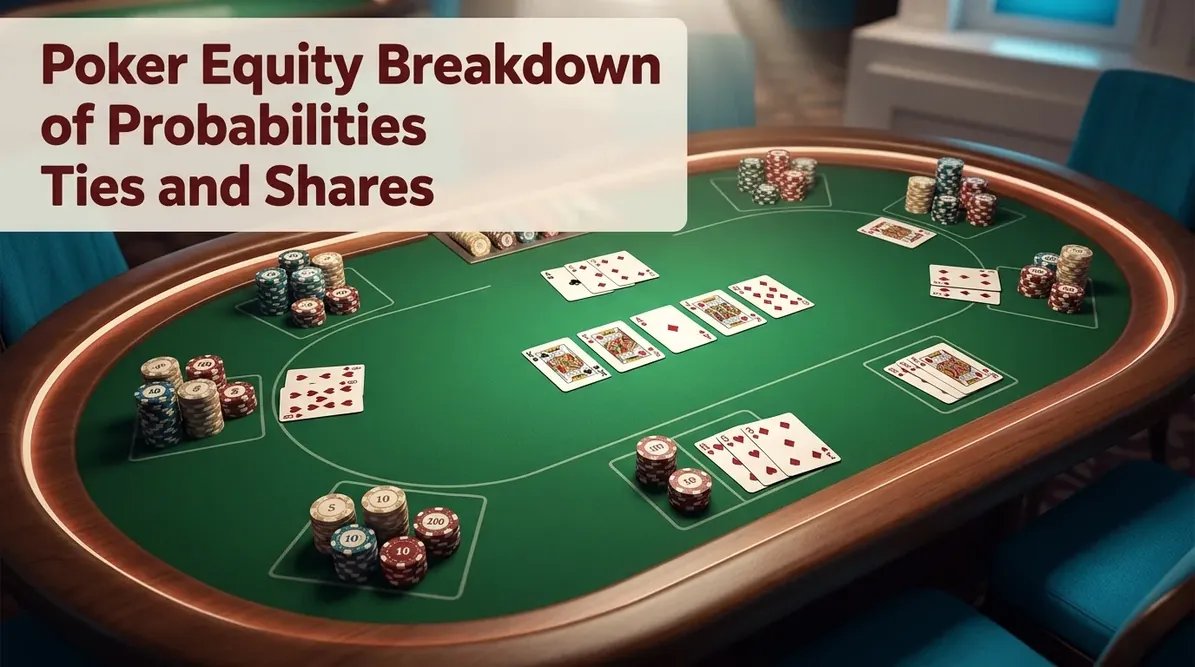
Poker Equity Breakdown of Probabilities Ties and Shares
Poker equity represents the share of the pot each hand can expect to receive, considering both outright wins and split pots based on the remaining cards. In a tie, the pot is divided equally: two players each get half, three each receive a third, and four each take a quarter. Over many hands, the total equity for all players always adds up to 100 percent. Unlike win probability, which only measures the chance of winning outright, equity also includes the possibility of splits. Players evaluate equity at each stage,flop, turn, and river,by counting outs, checking pot odds, and calculating expected value to guide their decisions during a hand.
Core Concept Of Poker Equity
Poker equity measures expected ownership of each pot share. It is calculated across all possible remaining board outcomes. Each street has distinct calculation demands, as each street has a different number of unseen cards still to come.
| Aspect | Description |
|---|---|
| Definition focus | Expected pot ownership percentage |
| Treatment of wins | Full pot awarded outright |
| Handling of ties | Split equally among winners |
| Long-run perspective | Repeating identical situations repeatedly |
| Dependence on remaining cards | Undealt community cards matter |
| Total equity across players | Sum equals one hundred |
Intended Users And Practical Uses

This text helps cash and tournament poker players, analysts, and gamblers use win-probability calculations to make decisions in Texas Hold’em and other variants. People use equity concepts to compare hands before the flop. This approach lets them plan their moves after the flop and decide when to check, bet, or fold.
- Preflop hand comparison;
- Postflop turn planning;
- River call decisions;
- All-in fold-or-shove spots;
- Multiway pot analysis;
- Range evaluation tools;
- Tournament push-fold strategy;
- Bankroll variance modeling.
Win Probability Versus Equity Share
Hand strength is measured in two ways: win probability and equity share. Win probability reflects the chance of winning but does not account for ties. Equity share includes the probability of winning and the portion of chips gained from tied pots. A hand that wins 40 percent of the time and ties 10 percent of the time has an equity share of 45 percent in heads-up play.
| Aspect | Win Probability | Equity Share |
|---|---|---|
| Counts ties | No, wins only | Yes, proportional share |
| Heads-up formula | W only | W + T ÷ 2 |
| Multiway treatment | Wins divided equally | Split-pot shares included |
| Relation to pot size | None directly | Determines ownership percentage |
Role Of Ties In Pot Shares
Tied results occur when two or more players have identical five-card hands. In a tie situation, players share the best five-card hand, and the pot is divided proportionally among all tied participants. Tie outcomes are neither full wins nor complete losses for any player. Key aspects of split pot mechanics are detailed.
- Equal five-card hands create tie outcomes;
- Playing the board produces identical results;
- Split pot division requires equal hand strength;
- Two-way ties award 50% shares;
- Three-way ties award 33.3% shares;
- Tie outcomes increase total equity percentages;
- Equity formula incorporates tie outcomes through addition;
- Shared pots reduce individual absolute winnings.
Splitting Pots In Multiway Ties
When three or more players reveal the same five-card hand at showdown, each player with the matching hand receives an equal share of the pot. If the chips cannot be divided, the player in the best seat position receives the extra chip.
| Tie Scenario | Pot Division |
|---|---|
| Three-way tie | One-third to each player |
| Four-way tie | One-quarter to each player |
| Small chip remainder | Distributed by seat position |
Exact Methods For Equity Calculation
To determine equity, consider all possible combinations of turn and river cards. For each scenario, assign an outcome as a win, tie, or loss. Listing every way the board can conclude allows calculation of equity. Finally, convert these results into percentages.
- Count total runouts;
- Record winning outcomes;
- Tally tied outcomes;
- Calculate win percentage;
- Determine tie percentage;
- Allocate tie shares proportionally;
- Sum win and allocated shares;
- Verify total combinations.
Operation Of Poker Equity Calculators
Users enter information such as hole cards, community cards, and opponent hand ranges into the software. The equity calculator processes all possible outcomes and provides the results. It shows the win and tie percentages. The calculator then displays the final equity shares for each player or range entered.
- Personal hand strength assessment;
- Range versus range scenario modeling;
- Multiway pot equity distribution;
- Graphical equity visualization across streets;
- Export functions for external review.
Hand Ranges And Equity Estimates
Players estimate equity by thinking about the possible hands their opponent could hold. Since opponents keep their cards hidden, players must consider all potential combinations. They list these hands using combinations and assign a weight to each one, which influences how they calculate equity. At every decision point, the range of hands includes all hands the opponent might have. Each action taken in the game narrows down these possibilities.
| Range Type | Typical Equity Effect |
|---|---|
| Tight | Cuts your equity sharply |
| Loose | Increases your equity often |
| Capped | Increases your equity moderately |
| Polarized | Creates variable equity shifts |
| Linear | Produces moderate equity changes |
Outs And Drawing Equity
Begin by identifying your outs, which are the unseen cards that could strengthen your hand. Each draw offers a specific number of outs. Once you determine this number, you can estimate your chances of winning at showdown. Drawing equity relies on your outs count and indicates the portion of the pot you might win. To calculate this, consider the remaining outs before both the turn and the river.
- Flush draw: nine outs;
- Open-ended straight draw: eight outs;
- Gutshot straight draw: four outs;
- Two overcards: six outs;
- Set draw: two outs.
Two And Four Rule For Fast Estimates
Players estimate their odds using the rule of two and the rule of four: with one card left, they multiply their outs by two; with two cards, by four. This method gives a quick result, but its accuracy decreases since it does not account for the types of outs or how opponents behave.
| Outs | Approximation |
|---|---|
| 4 outs | 8% one card / 16% two cards |
| 8 outs | 16% one / 32% two |
| 9 outs | 18% one / 36% two |
| 12 outs | 24% one / 48% two |
| 15 outs | 30% one / 60% two |
Pot Odds And Required Equity
Pot odds show the relationship between the call amount and the pot size, indicating the minimum equity needed to continue. By comparing their investment to potential winnings, players assess whether calling is profitable. If their hand’s equity exceeds this threshold, making the call results in a profit.
- 150-chip pot with a 50-chip call produces 3-to-1 pot odds and 25 percent required equity;
- 200-chip pot with a 100-chip call produces 2-to-1 pot odds and 33 percent required equity;
- Pot odds express call cost versus reward;
- Required equity formula: call ÷ (pot + call);
- Higher pot odds demand lower required equity;
- Lower pot odds demand higher minimum equity;
- Equity above threshold hints at profitability.
Using Equity In Expected Value Decisions
Equity does not solely determine poker profitability. Expected value assesses profitability by combining equity, potential winnings, and losses. The formula for expected value involves multiplying the chance of winning the pot by potential winnings and subtracting the risk multiplied by the chance of losing. Different decision types in poker use equity relationships differently in expected value calculations.
| Decision Type | How Equity Enters EV |
|---|---|
| Call | Compares hand equity to required threshold |
| Bluff | Uses fold equity and showdown equity |
| Value Bet | Weighs equity against opponent calling range |
| Fold | Sets equity contribution to zero |
Board Texture Impact On Equity
Equity shifts as community cards are revealed. The board’s texture influences the range of possible hands and draws for players. This alters the equity distribution among hands at the table. Paired boards favor players who can make full houses. Monotone boards offer opportunities to draw to flushes. On coordinated boards, multiple draws become available. Dry boards limit drawing possibilities. Players use blocker cards to lower the number of hands their opponents can make, which affects equity. Backdoor draws need two consecutive cards to complete.
- Paired board: favors full houses;
- Monotone board texture: creates flush draws;
- Coordinated board texture: enables straight draws;
- Dry board: restricts draws.
Position And Equity Realization
Card strength determines the raw equity behind decisions, and position does not affect the actual strength of a player’s hand. However, position influences a player’s ability to convert that equity into profit. Players who act later can observe opponents’ actions, allowing for more informed decisions before committing chips. Equity realization refers to the portion of a hand’s theoretical equity retained throughout play.
- See opponent actions first;
- Control pot size more easily;
- Extract maximum value reliably;
- Execute profitable bluffs safely;
- Acting early forces blind decisions;
- Early commitment reduces equity realization;
- Bluffing becomes riskier without information.
Equity Flow Across Betting Streets
Each new card alters equity during the hand. On the flop, equity accounts for two cards yet to come, causing swings due to wide ranges and possible draws. The turn narrows equity further with just one card left, and players either complete or miss their draws. By the river, with all community cards revealed, equity serves as the final measure of the hand. Once the last card is dealt, the outcome is determined.
| Street | Typical Equity Behavior |
|---|---|
| Preflop | Wide ranges, few blockers |
| Flop | Largest swings, many draws |
| Turn | Ranges narrow, draws diminish |
| River | Final measurement, no changes |
Step By Step Equity Evaluation
A workflow applies theory to guide hand analysis. Individuals follow consistent steps at each decision point, which leads to repeatable results.
- Identify the current street: flop, turn, or river;
- Assign opponent ranges: define the set of possible holdings the opponent can hold;
- Count your outs: identify the unseen cards that improve your holding to the winner;
- Estimate equity: apply the rule of two and four or use a calculator for equity calculation;
- Calculate pot odds: divide the call amount by the total final pot;
- Compare equity to threshold: check whether your equity calculation exceeds the required percentage.
Common Mistakes In Equity Reasoning
Experienced players make equity mistakes that affect decision quality. Equity mistakes occur from overcounting outs, omitting tie outcomes, or misjudging range strength. Miscalculations result in poor calls or folds by players. Patterns indicate common reasoning failures that decrease accuracy.
- Ignoring dirty outs completely;
- Overcounting actual winning cards;
- Discounting multiway split scenarios;
- Forgetting opponent range distributions;
- Conflating win percentage with equity;
- Neglecting board texture impact;
- Applying outdated out counts;
- Overlooking implied reverse odds.
Cash Game And Tournament Equity Differences
Equity means different things in each format. In a cash game, if you have 55 percent card equity, you may call. In a tournament, players often fold with the same equity. Tournament payout structures make players focus on survival, not growth.
| Cash | Tournament |
|---|---|
| Chip value constant | Chip value nonlinear |
| No survival penalty | Survival adds value |
| Rebuy available anytime | Elimination ends run |
| Linear equity use | Risk-adjusted equity use |
| No payout jumps | Payout jumps matter |
Preflop Equity Charts And Reference Tables
Many players use preflop charts and reference tables for hand selection. These resources show approximate equities against typical opponent ranges. Players can quickly consult these guides to compare starting hands and adjust their strategy based on the charts. Standard chart types include various formats.
- Hand versus random grid;
- Shove or fold table;
- Opening range matrix;
- Three-bet defense chart;
- Equity bucket reference.
Summary Of Key Poker Equity Points
Poker equity represents expected pot ownership by combining outright win percentages with the chances of tied outcomes. The distinction between outright win probability and actual equity is crucial when comparing with pot odds. Expected value calculations rely on accurate equity estimates, which adjust based on opponent ranges, board texture, and remaining streets in play.
- Compare equity to pot odds;
- Add tie shares to wins;
- Use ranges, not single hands;
- Recalculate equity each street;
- Apply outs with proper adjustments.
FAQ
What Is Poker Equity In Simple Terms?
Poker equity is the expected share of the pot over time. It is determined by the current cards in play and the possible outcomes of the remaining cards. Poker equity represents the average percentage of the pot a player would own if all possible outcomes were played to showdown.
How Much Equity Is Needed To Call?
To find the equity you need, work out the pot odds. Divide the amount you need to call by the pot, including your call. For example, if you call 50 chips and the pot holds 150 chips, you need 25 percent equity to break even.
Do Ties Change Real Equity?
Tied results affect equity. If a tie occurs, the pot is divided among the co-winners. Your equity share reflects these split portions from ties. Win percentage counts only outright wins.